Garage Door Won't Open? What to Check Safely
Start by deciding whether the door is stable. Simple control observations may help, but loaded hardware and a crooked door are stop conditions.
Call about a garage door that will not open, phone number 0485 021 377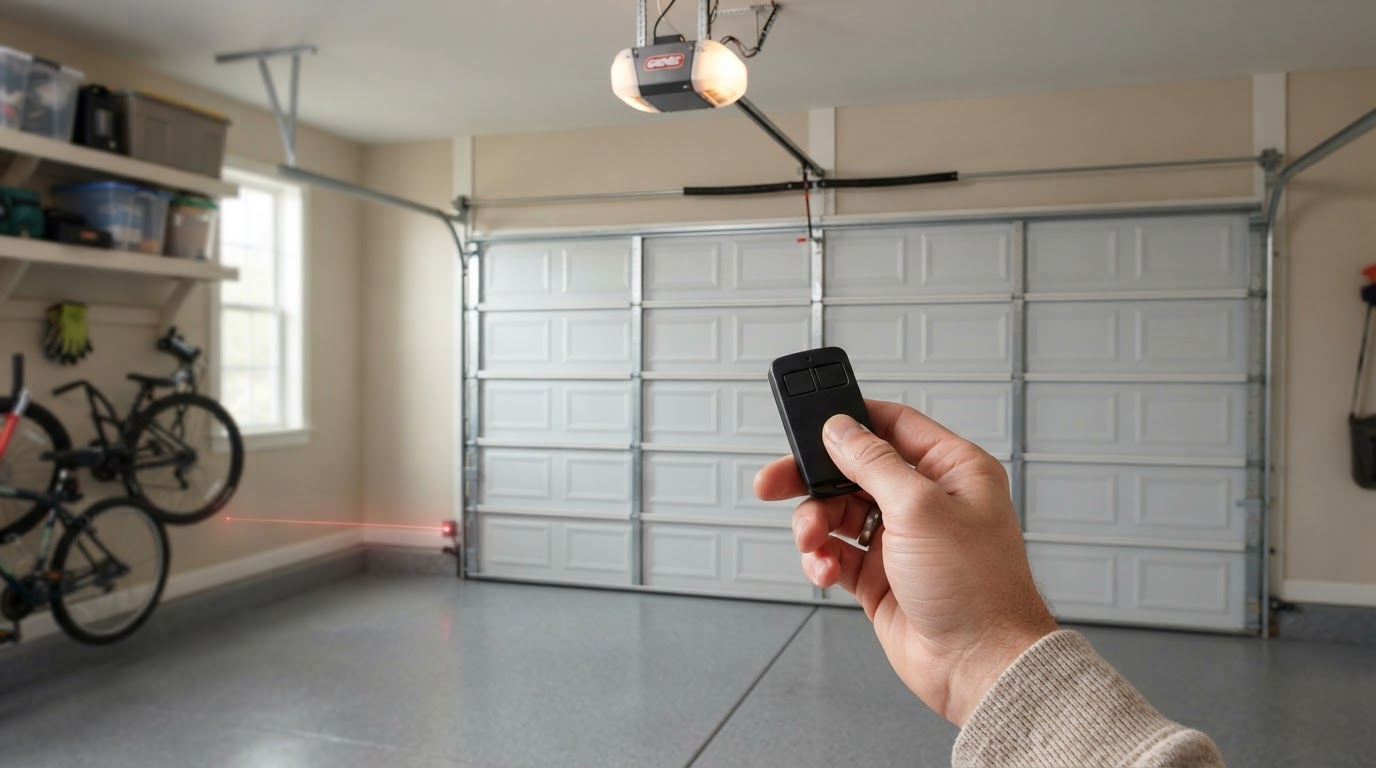
First decide whether the door is stable
Before checking controls, stand clear and look at the door from a safe position. If it is crooked, partly suspended, off-track, unusually heavy, or showing a loose cable or spring gap, stop. Those are mechanical warning signs, not remote-control troubleshooting.
Keep people and vehicles outside the movement path. Do not use the opener to drag the door straight, and do not pull the manual release on a raised or unstable door.
- Stable and fully closed: simple power and control observations may be appropriate.
- Open but stable: keep the area controlled and avoid repeated operation.
- Crooked, dropped or off-track: stop and arrange an assessment.
- Smoke, burning smell or damaged wiring: isolate only where safe and use an appropriate electrical or emergency response.
Low-risk checks for a closed, stable door
If the door is fully closed, stable and free of obvious mechanical damage, compare the easiest inputs before assuming the motor has failed. Use the manufacturer's instructions for the installed opener.
Do not open electrical covers, adjust force to overpower resistance or bypass photo-eyes. Stop as soon as the door strains, lifts unevenly or produces a new grinding or snapping sound.
- Confirm that the opener has power and that a relevant circuit breaker has not tripped.
- Try the wall control and another remote, if available.
- Replace a remote battery only in accordance with its instructions.
- Clear ordinary objects from the doorway and sensor line without reaching into moving hardware.
- Note indicator lights, beeps and where in the travel cycle the door stops.
No sound from any control
Observe: Power, wall control, receiver, controller or opener electronics may be involved.
Garage door opener repairMotor runs but the door barely moves
Stop condition: Drive, trolley, spring balance or binding hardware. Stop cycling.
Spring replacementDoor rises on one side
Stop condition: Cable, spring, drum, roller or track alignment. Keep clear.
Cable and track repairsDoor closes then reverses
Observe: Obstruction, sensor, travel setting or door resistance. Do not bypass sensors.
Opener repairRoller curtain scrapes or jams
Observe: Guides, curtain alignment, barrel, spring balance or motor load.
Roller door repairs
Treat the manual release as a safety device, not a universal fix
The manual release can disconnect an opener from the door, but the door remains heavy mechanical equipment. Follow the installed manufacturer's instructions only when the door is fully closed, stable and safe to move.
Do not release a raised door that may have a broken spring or cable. It can drop or become difficult to control. If there is doubt, leave it alone and describe the position by phone.
Common symptom patterns and the next owner page
The table is a guide to the system that may need inspection, not a remote diagnosis.
| What you observe | Possible systems involved | Useful next page |
|---|---|---|
| No sound from any control | Power, wall control, receiver, controller or opener electronics | Garage door opener repair |
| Motor runs but the door barely moves | Drive system, trolley, spring balance, cable or binding door hardware | Opener repair and spring safety |
| Door rises on one side | Cable, spring, drum, roller, track or panel alignment | Cable and track repairs |
| Door closes then reverses | Obstruction, sensor, travel setting, door resistance or closing-edge issue | Garage door opener repair |
| Roller curtain scrapes or jams | Guides, curtain alignment, barrel, spring balance or motor load | Roller door repairs |
Stop immediately if the door is unstable, heavy, off-track or moving unpredictably.
Prepare the repair call without creating more risk
State the door type, current position, what each control does, any visible mechanical warning sign and whether a vehicle or security issue is involved. A model number is optional if it is not safely readable.
A suitable enquiry may be connected with a local provider rated 4.5+ on Google at matching. That provider confirms current availability, diagnosis, scope, price and terms.
- Suburb and safe access route.
- Roller, sectional/panel, tilt or unknown door type.
- Wall-control, remote, motor and sensor observations.
- Sudden bang, impact, outage, grinding or change in balance.
- Door position and whether the opening is secure.
Phone call preparation checklist
- Door type and current position.
- Which controls work: wall button, remote, motor.
- Indicator lights, beeps and where the door stops.
- Any visible spring gap, loose cable or crooked edge.
- Sudden bang, impact, outage or change in balance.
- Your Brisbane suburb and safe access.