Roller Door vs Sectional Door Repair Issues
Door type changes the springs, guides, tracks, panels and motor arrangement. Identify how the door moves before comparing repair advice.
Call about a roller or sectional door, phone number 0485 021 377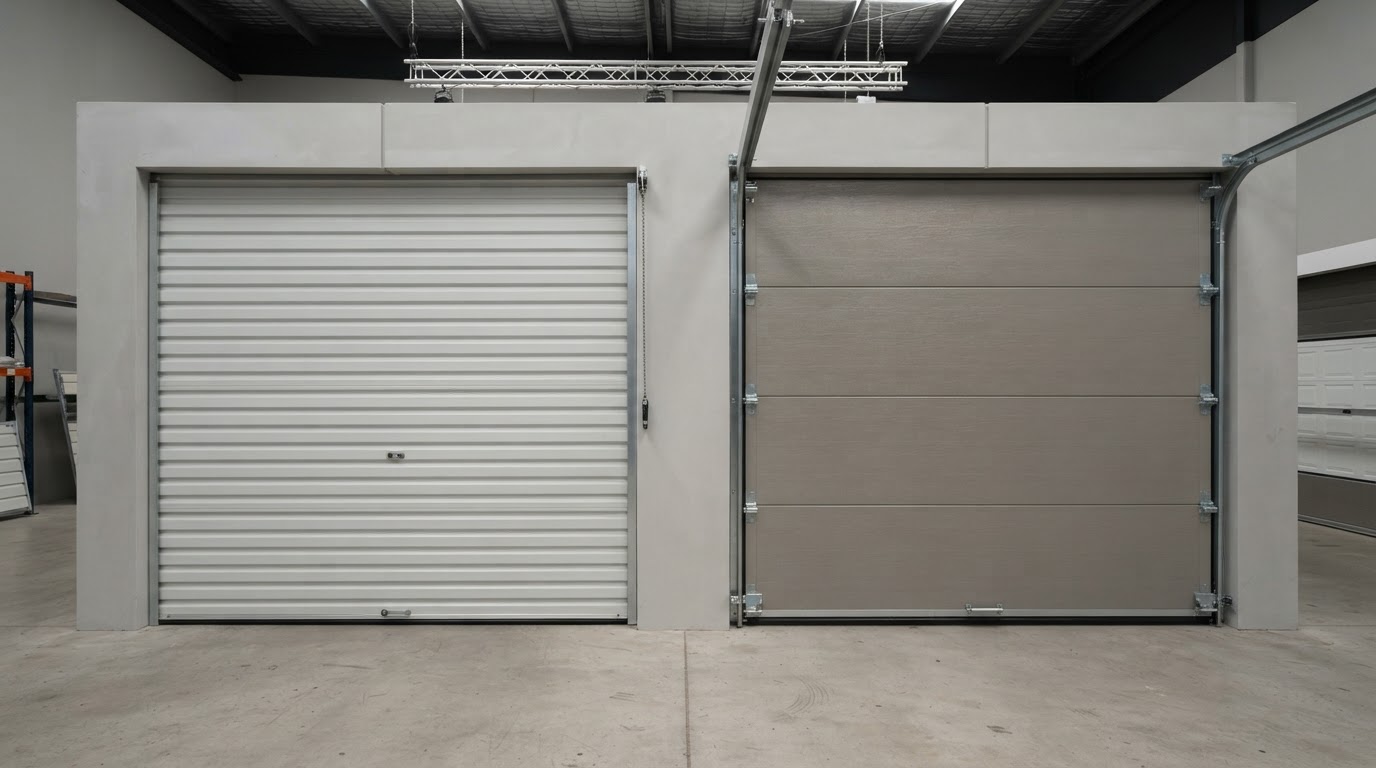
Roller and sectional doors move in different ways
A roller door uses a flexible curtain that travels in vertical guides and coils around an overhead barrel. A sectional door uses several hinged panels with rollers that travel through vertical and horizontal tracks. The opener, spring arrangement and common wear points differ.
A one-piece tilt door is another system again. Describe how the door moves before assuming that advice or parts for one type apply to another.
- Roller door: curtain, side guides, bottom rail, barrel, axle and internal spring arrangement.
- Sectional door: panels, hinges, rollers, tracks, cables, drums and spring system.
- Tilt door: one large panel, pivot arms or tracks and dedicated lifting hardware.
- Automatic operation: a motor or opener added to the mechanical door system.
A simple description of movement and construction is enough to begin. You do not need to climb, remove covers or approach loaded hardware to identify the system.
Roller-door symptoms often involve curtain travel and balance
A roller curtain may scrape a guide, skew, crease, become heavy, drop or roll unevenly onto the barrel. The motor can also stop or strain because the curtain or spring system is binding.
A provider should inspect the curtain profile, guides, bottom rail, barrel, axle, bearings, brackets, spring balance and motor as applicable. A badly damaged curtain or internal spring arrangement may change the repair-versus-replacement decision.
- Rubbing or fraying at one guide.
- Sloping bottom rail or curtain outside a guide.
- Heavy manual movement or uncontrolled drop.
- Motor movement without smooth curtain travel.
- Creases or impact damage that affect rolling.
Sectional-door symptoms often involve panels, rollers and lifting hardware
A sectional door can click at a hinge, bind in a track, rise unevenly after a cable problem or become extremely heavy after spring failure. A damaged panel can also affect alignment and roller travel.
The assessment should cover panel and hinge condition, rollers and tracks, cables and drums, springs, brackets and opener load. Replacing one visible component may not correct the initiating fault.
- Roller leaves the track or binds at a track curve.
- Panel joint or hinge moves abnormally.
- One side rises ahead of the other.
- Visible spring gap or loose cable.
- Opener strains against a heavy or misaligned door.
Repair questions by door type
Use this comparison to ask for the right scope rather than to diagnose the door remotely.
| Question | Roller door | Sectional door |
|---|---|---|
| What carries the door? | Curtain, barrel, axle, guides and internal spring system | Panels, hinges, rollers, tracks, cables, drums and springs |
| What can impact damage affect? | Curtain profile, bottom rail, guides, barrel alignment | Panels, hinges, rollers, tracks and cable alignment |
| What can overload the motor? | Binding guides, damaged curtain, poor balance or spring fault | Heavy door, spring failure, track binding, cable or roller fault |
| What should a quote identify? | Curtain versus complete door, guides, spring/barrel and motor scope | Panels, rollers, tracks, cables, springs and opener scope |
| What is unsafe to adjust? | Internal spring/barrel and loaded brackets | Springs, cables, drums and loaded bottom brackets |
Door type changes the components, but the same rule applies: stop if the system is unstable and do not work on loaded hardware.
Replacement triggers also differ
A creased roller curtain may no longer roll reliably even if the motor works. A sectional door may permit a compatible panel repair, but availability, colour and alignment affect the result. Both systems can require full replacement after extensive damage, obsolete components or a condition that cannot provide reliable movement.
Ask for the functional and cosmetic outcome of repair and a complete installed scope for replacement.
| Consider repair when | Compare replacement when |
|---|---|
| The fault is isolated to a replaceable spring, cable, roller, hinge, control or supported opener part. | The curtain or panels are extensively deformed, or critical hardware is obsolete. |
| The door remains structurally sound and aligns correctly. | Corrosion or fatigue affects several structural systems. |
| Compatible parts are available and the opener is suitable once corrected. | The opening or door no longer suits the intended use, or repeated repairs have not been reliable. |
| The expected repair outcome meets your priority. | A complete installed replacement scope may better meet the outcome. |
Ask the provider to explain the door condition that supports repair or replacement. A price advertised for one provider and scope is not automatically a general Brisbane price.
A short description is enough for the first call
Say whether the door rolls around a barrel, bends in hinged panels or tilts as one piece. Then describe the current position, symptom, controls and any impact or security concern.
Suitable enquiries may be connected with a local provider rated 4.5+ on Google at matching. The provider confirms whether it has the right capability, current availability, scope, price and terms.
Phone call preparation checklist
- Door type: roller, sectional/panel, tilt or unknown.
- Current position and whether the opening is secure.
- Main symptom and which controls are affected.
- Any impact, security concern or recent change.
- Your Brisbane suburb and safe access.